Artists & Brands

ERNST Max

image Germany
1891 - 1976
13 lots
image ERNST Max

Max Ernst (1891–1976) was a German-born artist and one of the most influential figures in Surrealism and Dada. Born in Brühl, Germany, he studied philosophy and psychology before turning to art, experiences that later shaped his fascination with dreams, the unconscious, and irrational imagery. After serving in World War I, Ernst became a founding member of the Cologne Dada group. In the 1920s, he moved to Paris and joined the Surrealists, developing innovative techniques such as frottage (rubbing textures onto paper), grattage (scraping paint), and decalcomania. These methods allowed chance and subconscious processes to guide his work, producing strange, dreamlike landscapes and hybrid creatures. Ernst’s art often combines precise detail with fantastical elements, challenging traditional perceptions of reality. His recurring motifs include birds, forests, and mysterious figures, reflecting his personal symbolism. With the outbreak of World War II, Ernst emigrated to the United States, where he influenced the emerging Abstract Expressionist movement. He later returned to Europe, settling in France. Over his long career, he worked in painting, sculpture, collage, and printmaking. Today, Max Ernst is celebrated as a pioneer who expanded the boundaries of artistic imagination and experimental technique.

image Nocturne
Nocturne
PaintingOil1963
Sold For
$38,100
May 2026MAX ERNST (1891-1976)| Nocturne | signed 'max ernst' (lower right); signed again and titled 'NOCTURNE max ernst' (on the reverse)| oil on canvas laid down on panel| 4 5⁄8 x 16 ¼ in. (11.9 x 41.4 cm.)| Painted in 1963|
image Dancers under the starry sky
Dancers under the starry sky
PaintingOil1951
Sold For
€115,200
April 2026Max Ernst|Dancers under the starry sky|Property from a Prestigious European Collection|1891-1976|signed max ernst and dated 51 (lower right)|oil on board on cradled panel|57,5 x 40,5 cm; 22⅝ x 16 in.|Executed in 1951.
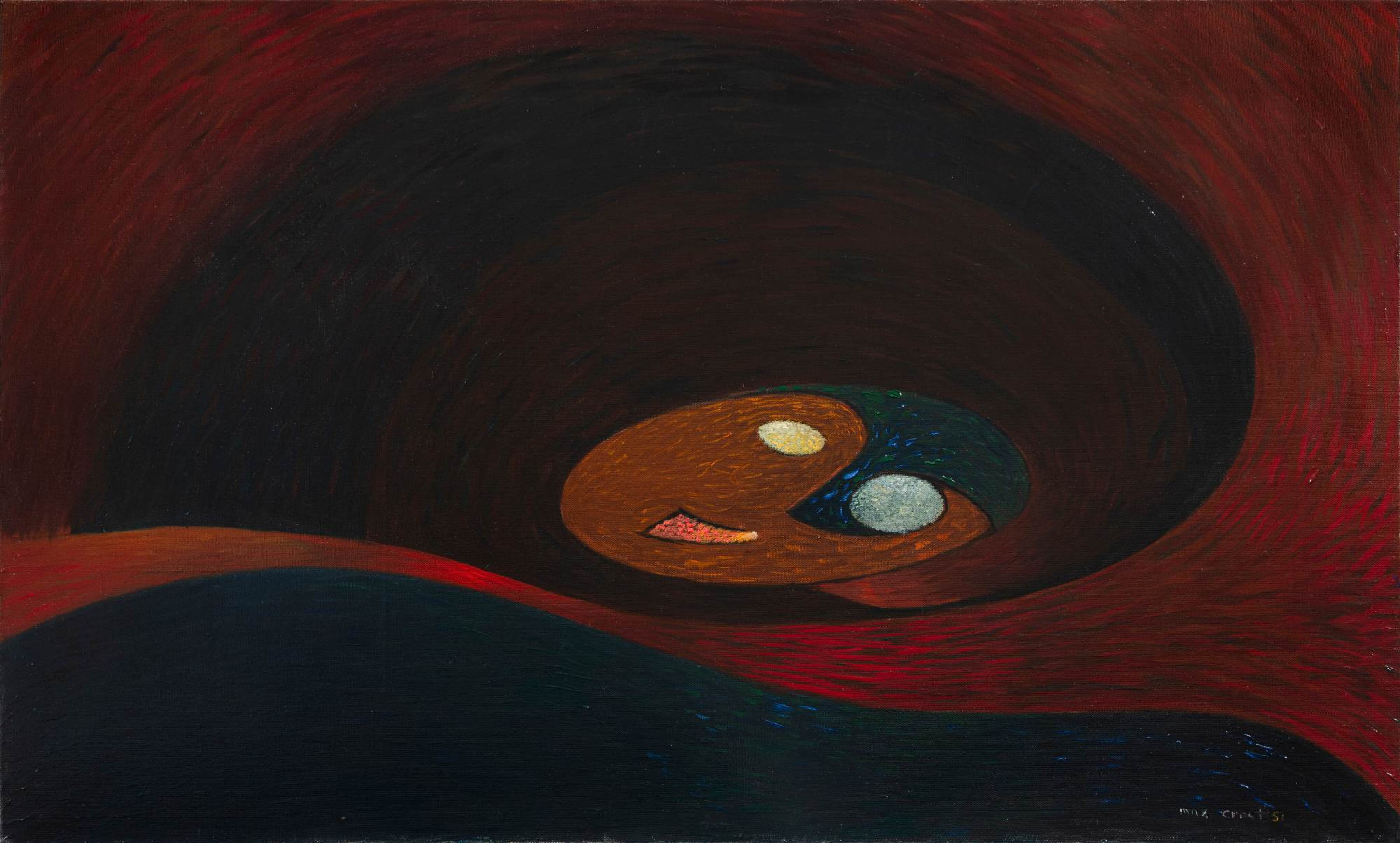
image Comète
Comète
PaintingOil1951
Sold For
€320,000
April 2026Max Ernst|Comète|1891 - 1976|signed max ernst and dated 51 (lower right); signed max ernst, titled comète and dated 1951 (on the reverse)|oil on canvas|61,2 x 101,1 cm; 24⅛ x 39¾ in.|Executed in 1951.|The authenticity of this work has been confirmed by Dr. Jürgen Pech, Bonn. This work will be included in the supplementary volume of the complete work of Max Ernst in preparation edited by Werner Spies, Sigrid Metken and Jürgen Pech.
image Sans titre (L'oiseau qui s'assoit et ne chante pas)
Sans titre (L'oiseau qui s'assoit et ne chante pas)
UncategorizedOil1926
Sold For
$630,000
November 2024MAX ERNST (1891-1976)| Sans titre (L'oiseau qui s'assoit et ne chante pas) | signed twice 'max ernst' (lower right)| oil, sand and grattage on canvas| 26 5⁄8 x 21 ¼ in. (68.3 x 54 cm.)| Painted in 1926|
image La Terre est une femme
La Terre est une femme
PaintingOil1963
Sold For
$825,500
May 2023Max Ernst|La Terre est une femme|1891 - 1976|signed Max Ernst and dated 63 (lower right)|oil on canvas|25 ⅝ by 21 ⅛ in. 65.2 by 53.8 cm.|Executed in 1963.
image Paysage
Paysage
Painting1963
Sold For
CHF 38,100
March 2023Max Ernst|Paysage|1891-1976|signed Max Ernest (lower right)|gouache on board|9 x 12 cm (unframed); 26 x 29 cm (framed)|Executed in 1963.|The authenticity of this work has been confirmed by Dr. Jürgen Pech.
image Son terrible chant d'amour éclate entre deux lits de glace, Sept microbes (9)
Son terrible chant d'amour éclate entre deux lits de glace, Sept microbes (9)
Painting1951
Sold For
€27,720
March 2022Max Ernst (1891-1976)| Son terrible chant d'amour éclate entre deux lits de glace, Sept microbes (9)| gouache et décalcomanie sur papier| Image: 5.2 x 4.1 cm.| Montage: 44.3 x 40.6 cm.| Exécuté vers 1951; le montage fait probablement par l'artiste| | gouache and décalcomanie on paper| Image: 2 x 1 5⁄8 in.| Mount: 17 1⁄2 x 16 in.| Executed circa 1951; the mount probably made by the artist|
image Migration
Migration
PaintingOil1963
Sold For
£92,500
February 2016Max Ernst (1891-1976)| Migration | signed and dated 'max ernst 63' (lower right)' signed and dated 'max ernst 1963' (on the reverse)| oil on panel| 10 5/8 x 13¾ in. (27.2 x 35 cm.)| Painted in 1963|
image Configuration
Configuration
PaintingOil1974
Sold For
£74,500
June 2014Max Ernst (1891 - 1976) | Configuration | oil on panel | 33.4 by 41.2cm., 13⅛ by 16⅛in. | Condition: The panel is sound and there do not appear to be any signs of retouching visible under UV light. There is some very minor surface dirt in a few places and a very small spot of frame rubbing at the centre of the left edge from previous framing. This work is in overall very good condition. "In response to your inquiry, we are pleased to provide you with a general report of the condition of the property described above. Since we are not professional conservators or restorers, we urge you to consult with a restorer or conservator of your choice who will be better able to provide a detailed, professional report. Prospective buyers should inspect each lot to satisfy themselves as to condition and must understand that any statement made by Sotheby's is merely a subjective, qualified opinion. Prospective buyers should also refer to any Important Notices regarding this sale, which are printed in the Sale Catalogue.NOTWITHSTANDING THIS REPORT OR ANY DISCUSSIONS CONCERNING A LOT, ALL LOTS ARE OFFERED AND SOLD AS IS" IN ACCORDANCE WITH THE CONDITIONS OF BUSINESS PRINTED IN THE SALE CATALOGUE."
image La Création du monde
La Création du monde
PaintingOil1951
Sold For
€109,500
December 2013Max Ernst (1891 - 1976) | La Création du monde | oil on paper laid down on masonite | 22 by 23 cm ; 8 5/8 by 9 in. | Condition: The paper and masonite board are sound. There is no evidence of retouching under UV light. This work is in excellent original condition."In response to your inquiry, we are pleased to provide you with a general report of the condition of the property described above. Since we are not professional conservators or restorers, we urge you to consult with a restorer or conservator of your choice who will be better able to provide a detailed, professional report. Prospective buyers should inspect each lot to satisfy themselves as to condition and must understand that any statement made by Sotheby's is merely a subjective, qualified opinion. Prospective buyers should also refer to any Important Notices regarding this sale, which are printed in the Sale Catalogue.NOTWITHSTANDING THIS REPORT OR ANY DISCUSSIONS CONCERNING A LOT, ALL LOTS ARE OFFERED AND SOLD AS IS" IN ACCORDANCE WITH THE CONDITIONS OF BUSINESS PRINTED IN THE SALE CATALOGUE."
image Dancers Under the Starry Sky
Dancers Under the Starry Sky
PaintingOil1951
Sold For
$459,750
May 2013Max Ernst (1891-1976) | Dancers Under the Starry Sky | signed and dated 'max ernst 51' (lower right) | oil on canvas | 30 x 18 1/8 in. (76.2 x 46 cm.) | Painted in 1951 |
image GULFSTREAM
GULFSTREAM
PaintingOil1926
Sold For
£174,500
February 2008Max Ernst (1891-1976) | GULFSTREAM | oil on canvasboard | 55 by 46cm., 21 5/8 by 18 1/8 in. | The present work is part of the La Mer series that Ernst executed around the mid-1920s. During the summer of 1925 Ernst worked by the sea at Pornic in Brittany, and it was probably during this trip that inspired the sea imagery. This was a particularly eventful year for the artist: he signed his first commercial contract, which provided him the financial freedom to devote his time entirely to painting and experimentation; he participated in the first Surrealist group exhibition at the Galerie Pierre, and he developed the frottage technique, one of the most consequential inventions of career. Frottage consisted of placing paper over objects such as leaves or uneven surfaces, particularly those with wood graining, and rubbing the sheet over those forms and textures. This technique resulted in fantastical images that ignited the artist's imagination, and involved the element of chance, the key concept in Surrealist thought. This scraping technique reveals the image rather than painting it onto canvas, resulting in random, chance imagery. In this way, Max Ernst was the first to invent a way of applying automatism, previously practiced by the Surrealists in a literary medium, to painting.Adapting this practice to the medium of oil painting, Ernst would cover the canvas with layers of paint and place it over an uneven surface or an object. He would then scrape the pigment off the surface, and complex patterns would emerge. In the present work, he probably incised the wet oil surface with a comb, creating elegant, undulating lines that evoke the effect of currents and waves on the water surface. Discussing this grattage technique, Werner Spies wrote: 'Max Ernst laid his canvas over various objects with raised textures - pieces of wood and string, grates, textured glass panes - and, drawing the paint over them with a palette knife, brought forth the most vivid effects. In the course of the following years - years which William Rubin has called the 'heroic epoch of Surrealist painting' - this technique, known as grattage, led to astonishingly innovative imagery. The pictures became more abstract in effect, their formats larger. The dramatic force of these paintings, the richness of their scintillating colour, made them high points of imaginative Surrealist art in the late 1920s' (W. Spies, Max Ernst. A Retrospective (exhibition catalogue), Tate Gallery, London, 1991, p. 148).
An unhandled error has occurred. Reload 🗙