Artists & Brands

ERNST Max

image Germany
1891 - 1976
16 lots
image ERNST Max

Max Ernst (1891–1976) was a German-born artist and one of the most influential figures in Surrealism and Dada. Born in Brühl, Germany, he studied philosophy and psychology before turning to art, experiences that later shaped his fascination with dreams, the unconscious, and irrational imagery. After serving in World War I, Ernst became a founding member of the Cologne Dada group. In the 1920s, he moved to Paris and joined the Surrealists, developing innovative techniques such as frottage (rubbing textures onto paper), grattage (scraping paint), and decalcomania. These methods allowed chance and subconscious processes to guide his work, producing strange, dreamlike landscapes and hybrid creatures. Ernst’s art often combines precise detail with fantastical elements, challenging traditional perceptions of reality. His recurring motifs include birds, forests, and mysterious figures, reflecting his personal symbolism. With the outbreak of World War II, Ernst emigrated to the United States, where he influenced the emerging Abstract Expressionist movement. He later returned to Europe, settling in France. Over his long career, he worked in painting, sculpture, collage, and printmaking. Today, Max Ernst is celebrated as a pioneer who expanded the boundaries of artistic imagination and experimental technique.

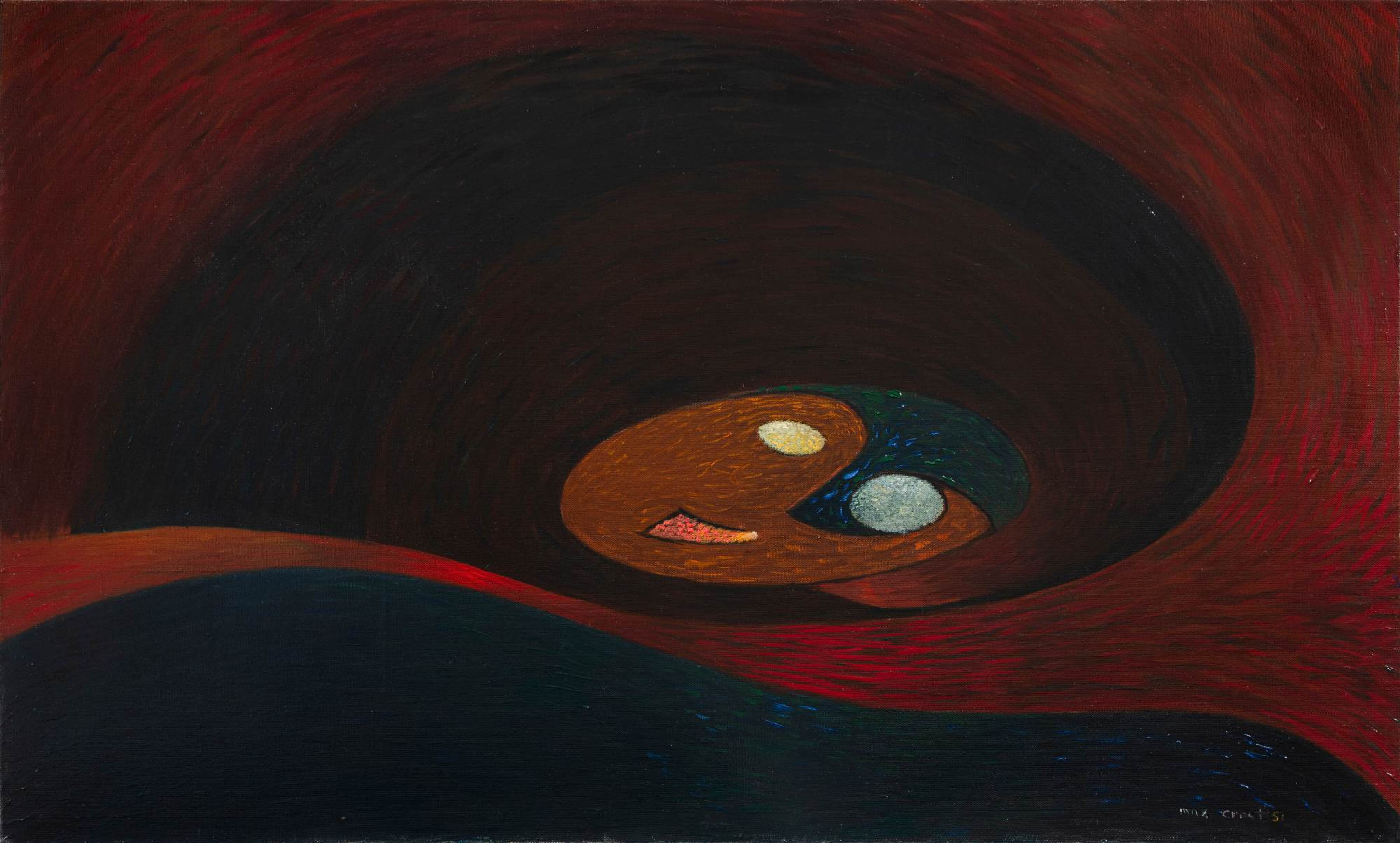
image Dancers under the starry sky
Dancers under the starry sky
PaintingOil1951
Sold For
€115,200
April 2026Max Ernst|Dancers under the starry sky|Property from a Prestigious European Collection|1891-1976|signed max ernst and dated 51 (lower right)|oil on board on cradled panel|57,5 x 40,5 cm; 22⅝ x 16 in.|Executed in 1951.
image Comète
Comète
PaintingOil1951
Sold For
€320,000
April 2026Max Ernst|Comète|1891 - 1976|signed max ernst and dated 51 (lower right); signed max ernst, titled comète and dated 1951 (on the reverse)|oil on canvas|61,2 x 101,1 cm; 24⅛ x 39¾ in.|Executed in 1951.|The authenticity of this work has been confirmed by Dr. Jürgen Pech, Bonn. This work will be included in the supplementary volume of the complete work of Max Ernst in preparation edited by Werner Spies, Sigrid Metken and Jürgen Pech.
image Submarines Stilleben
Submarines Stilleben
PaintingOil1917
Sold For
$279,400
November 2025MAX ERNST (1891-1976)| Submarines Stilleben | signed 'Max Ernst' (lower left)| oil on canvas| 22 ½ x 24 ¾ in. (57.1 x 63.8 cm.)| Painted in 1917|
image Le Père: "Votre baiser me semble adulte, mon enfant, Venu de Dieu, il ira loin. Allez, ma fille, allez en avant et..."
Le Père: "Votre baiser me semble adulte, mon enfant, Venu de Dieu, il ira loin. Allez, ma fille, allez en avant et..."
Painting1929
Sold For
£82,550
September 2025Max Ernst|Le Père: "Votre baiser me semble adulte, mon enfant, Venu de Dieu, il ira loin. Allez, ma fille, allez en avant et..."|1891 - 1976|signed max ernst (on the artist's mount)|collage mounted on paper|sheet: 24.3 by 19.3 cm. 9½ by 7⅝ in.|artist's mount: 30 by 23.3 cm. 11⅞ by 9⅛ in.|Executed in 1929-30.
image "...jusqu'à épuisement complet des beaux danseurs!"
"...jusqu'à épuisement complet des beaux danseurs!"
Painting1929
Sold For
£60,960
September 2025Max Ernst|"...jusqu'à épuisement complet des beaux danseurs!"|1891 - 1976|signed max ernst (lower right)|collage mounted on paper|sheet: 24.7 by 19.4 cm. 9¾ by 7⅜ in.|artist's mount: 29.8 by 24.4 cm. 11¾ by 9⅝ in.|Executed in 1929-30.
image Loplop présente
Loplop présente
SculptureOil1929
Sold For
£165,100
September 2025Max Ernst|Loplop présente|1891 - 1976|signed max ernst and numbered 5/6 (lower right)|oil and collage on plaster|99.2 by 120.6 cm. 39⅛ by 47½ in.|Executed in 1929-68. This work is number 5 from an edition of 7.
image L'oiseau magnétique
L'oiseau magnétique
PaintingOil1968
Sold For
£69,850
September 2025Max Ernst|L'oiseau magnétique|1891 - 1976|signed max ernst (lower right)|oil, wax crayon, gouache, pastel, pencil and collage on plywood|46.7 by 39 cm. 18⅜ by 15¼ in.|Executed in 1968.
image Demi-figure
Demi-figure
Uncategorized1968
Sold For
£0
March 2024MAX ERNST (1891-1976)| Demi-figure | signed and dated '1968 - max ernst' (lower right); inscribed 'DEMI-FIGURE' (lower left)| gouache, ink, pencil and paper collage on card| 14 1⁄8 x 11 in. (36 x 28 cm.)| Executed in 1968|
image Son terrible chant d'amour éclate entre deux lits de glace, Sept microbes (9)
Son terrible chant d'amour éclate entre deux lits de glace, Sept microbes (9)
Painting1951
Sold For
€27,720
March 2022Max Ernst (1891-1976)| Son terrible chant d'amour éclate entre deux lits de glace, Sept microbes (9)| gouache et décalcomanie sur papier| Image: 5.2 x 4.1 cm.| Montage: 44.3 x 40.6 cm.| Exécuté vers 1951; le montage fait probablement par l'artiste| | gouache and décalcomanie on paper| Image: 2 x 1 5⁄8 in.| Mount: 17 1⁄2 x 16 in.| Executed circa 1951; the mount probably made by the artist|
image La femme demi-tête
La femme demi-tête
Sculpture1917
Sold For
$112,500
November 2021LEONORA CARRINGTON (1917-2011) AND MAX ERNST (1891-1976)| La femme demi-tête | signed, numbered and inscribed with foundry mark 'max ernst EA III/IV E. GODARD Fondr' (on the back)| bronze with green and brown patina| Height: 69 in. (175.3 cm.)| Conceived in 1937; this bronze version cast in 1994|
image Buste d'oiseau
Buste d'oiseau
Painting1968
Sold For
€0
June 2020Max Ernst (1891-1976)| Buste d'oiseau| signé et daté 'max ernst/ 68' (en bas à droite); signé, daté et inscrit 'Buste d'oiseau max ernst 68' (au revers)| collage, gouache et crayon gras sur carton| 75.2 x 52.3 cm.| Exécuté en 1968 | | signed and dated 'max ernst/ 68' (lower right); signed, dated and inscribed 'Buste d'oiseau max ernst 68' (on the reverse)| collage, gouache and wax crayon on board| 29 ½ x 20 ½ in.| Executed in 1968|
image Le désert
Le désert
PaintingOil1929
Sold For
£842,500
June 2014Max Ernst (1891 - 1976) | Le désert | oil on canvas | 60 by 81cm. | 23 5/8 by 31 7/8 in. | Painted during an important period of experimentation for Ernst, Le désert is a compelling and powerful testament to his technical innovation. Ernst had always looked for new approaches to applying pigment that broke with traditional modes of representation, and his discovery of frottage in 1925 would prove a pivotal moment in his career. On holiday in Pornic, France at the time, Ernst described the moment in some detail in his Biographical Notes, ‘a rainy day in a seaside inn found me gazing at the floor boards of my room. My gaze became excited, then obsessed by the sight of the boards, where a thousand rubbings had deepened the groves [sic]. I decided then to investigate the meaning of this obsession and, to help my meditative and hallucinatory faculties, I made a series of drawings by placing on the boards sheets of paper, which I rubbed with black lead. I gazed at the drawings and, surprisingly, a hallucinatory succession of contradictory images rose before my eyes… A series of suggestions and transmutations offered themselves spontaneously’ (M. Ernst, Biographical Notes, 1925, reproduced in W. Spies, Max Ernst. Life and Work, Cologne, 2005, p. 100). This rich, new source of imagery was rapidly refined by Ernst, initially in a series of works on paper, and then, in a further development into the associated technique of grattage in which he covered canvases with a layer of paint before placing them over an object and scraping off the pigment to reveal the patterned surface beneath. Among the first manifestations of this technique were Ernst’s coquillages (fig. 1), in which he created still lifes and landscapes – similar to the present work - that combined large planes of abstract colour with the seemingly organic structures of flowers or shells created through grattage. As Ernst was immediately aware, the spontaneous suggestiveness of these techniques responded directly to Surrealist theory, yet these works were never entirely ‘automated’ as their composition was always subject to conscious decision on the part of the artist. As Werner Spies writes, ‘The textures of the objects Ernst placed under the canvas and lent a voice by means of the grattage technique suggested a stream of consciousness of the kind activated by ‘automatic writing’. Yet the flow of lines and shapes always remained subordinate to a definite pictorial conception, whether of the human figure, of birds, ‘hordes’ and advancing barbarians or forests and landscapes. This approach to painting arose from a dialectic between activity and passivity that began to play an increasingly central role in the artist’s work at this time’ (W. Spies, Max Ernst. A Retrospective, (exhibition catalogue), Tate Gallery, London, 1991, p. 148). In Le désert, Ernst conjures a bare and expansive landscape in which strange, almost skeletal monoliths rise from the earth like vestiges of an ancient civilisation. Spies has described the canvases of this period as containing a ‘prescience of imminent disaster’ (W. Spies, ibid., p. 148) and in Le désert Ernst captures this sense of the uncanny. The quasi-archaeological fragments in the foreground pre-empt his later visions of ruined cities, whilst the small orb which casts its light over the vivid red sand and swathes of blue sky is a motif that reappears in many of Ernst’s looming, primordial forests (fig. 2). A masterful example of Ernst’s contribution to the Surrealist œuvre, the absorbing power of this work is also in part due to the way it remains grounded in a sense of reality through his use of grattage. As Karin von Maur writes, ‘Ultimately derived from nature itself, this procedure gave rise to landscape visions which, thanks to their partial imitation of the growth patterns and textures of plants, evoked nature far more intensely than the traditional techniques of realism’ (K. von Maur in W. Spies, ibid., p. 343).
An unhandled error has occurred. Reload 🗙